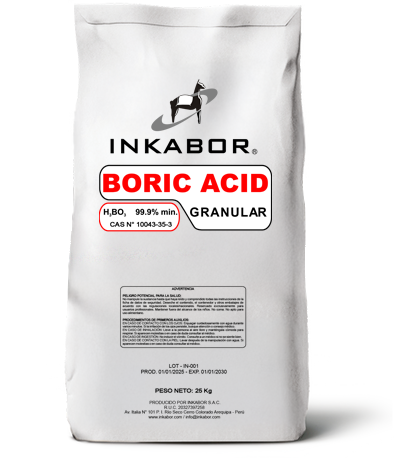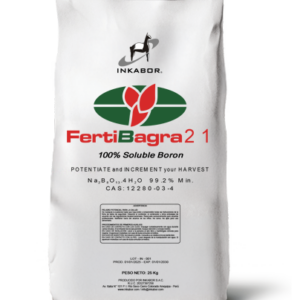
Boric Acid
| CAS | 10043-35-3 |
|---|---|
| Main Nutrient % | B – 17.4% |
Use cases for Boric Acid
Used for weatherproofing and fireproofing fabrics; as a preservative; manufacture of cements, crockery, porcelain, enamels, glass, borates, leather, carpets, hats, soaps, artificial gems; in nickel plating baths. The primary industrial use of boric acid is in the manufacture of monofilament fiberglass usually referred to as textile fiberglass. Textile fiberglass is used to reinforce plastics in applications that range from boats, to industrial piping to computer circuit boards. Also used in the manufacture of cosmetics; ointments and eye washes; printing and dyeing, photography; for impregnating wicks; hardening steel; in welding flux and copper brazing. Insecticide for cockroaches and carpet beetles; fungus control for citrus fruits. Boric acid also prevents and destroys existing wet and dry rot in timbers. It can be used in combination with an ethylene glycol carrier to treat external wood against fungal and insect attack. It is possible to buy borate-impregnated rods for insertion into wood via drill holes where dampness and moisture is known to collect and sit. It is available in a gel form and injectable paste form for treating rot affected wood without the need to replace the timber. Concentrates of borate-based treatments can be used to prevent slime, mycelium, and algae growth, even in marine environments. Boric acid is added to salt in the curing of cattle hides, calfskins, and sheepskins. This helps to control bacteria development, and helps to control insects. Colloidal suspensions of nanoparticles of boric acid dissolved in petroleum or vegetable oil can form a lubricant on ceramic or metal surfaces with a coefficient of sliding friction that decreases with increasing pressure to a value ranging from 0.10 to 0.02. Self-lubricating H3BO3 films result from a spontaneous chemical reaction between water molecules and B2O3 coatings in a humid environment. In bulk-scale, an inverse relationship exists between friction coefficient and Hertzian contact pressure induced by applied load. Boron is used in pyrotechnics to prevent the amide-forming reaction between aluminum and nitrates. A small amount of boric acid is added to the composition to neutralize alkaline amides that can react with the aluminum. Boric acid is used in nuclear power plants as a neutron poison to slow down the rate at which fission is occurring. Natural boron is 20% boron-10 and about 80% boron-11. Boron-10 has a high cross-section for absorption of low energy (thermal) neutrons. By adding more boric acid to the reactor coolant which circulates through the reactor, the probability that a neutron can survive to cause fission is reduced. Therefore, changes in boric acid concentration effectively regulate the rate of fission taking place in the reactor. This method is only used in pressurized water reactors (PWRs)
Synonyms for Boric Acid
B-H3-O3; B(OH)3; boracic acid; Borofax; hydrogen borate; orthoboric acid; trioxoboric (III) acid; trihydrooxidoboron; trihydroxyborane; component of Aci-Jel; boron hydroxide; boron trihydroxide; NCI-C56417; Borsaure; Homberg’s salt; Boorzuur; Sassolite; Optibor; APS TECH00005138 BP00004219 AR00000101; UL00000942 UL00000102 TECH00000934; Redox BOACID70